September 28, 2026
Four wheeler loan, used car finance
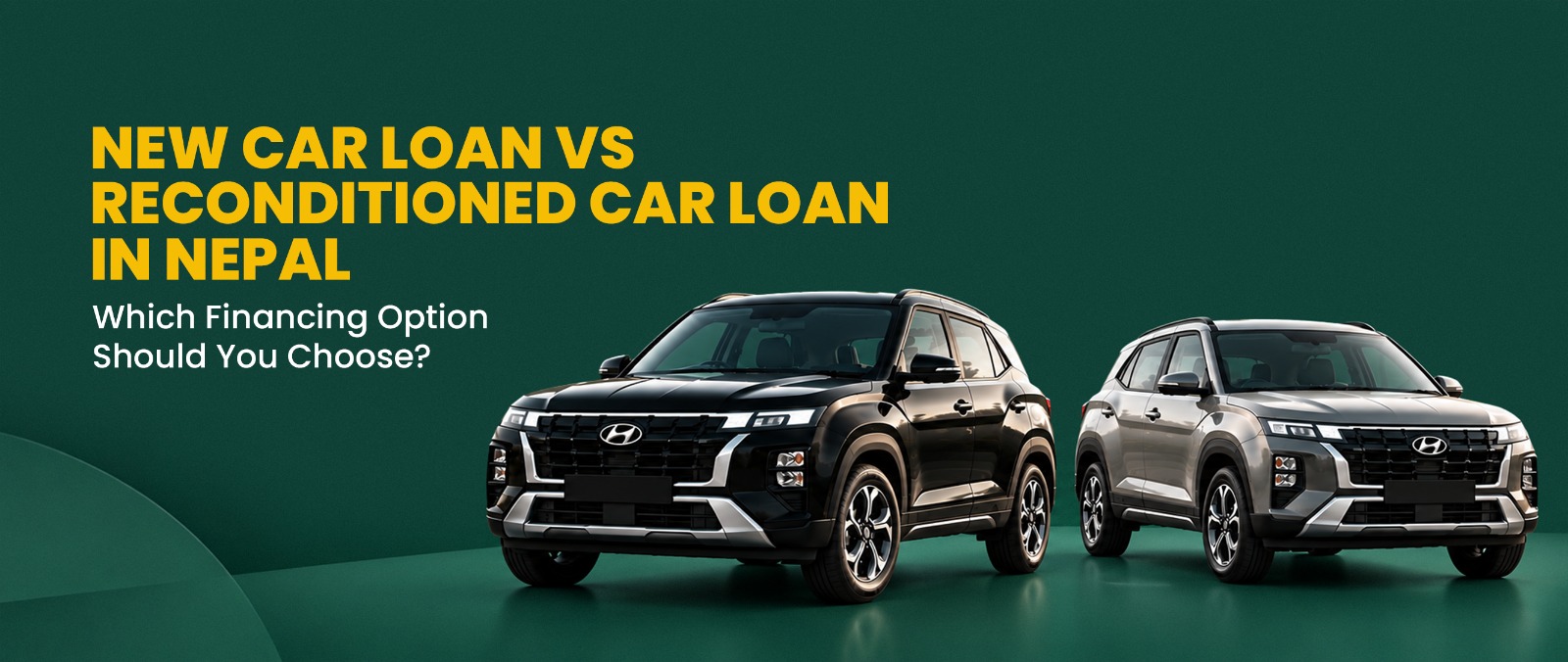
Buying a car is a major financial decision, and choosing the right financing option can be just as important as choosing the vehicle itself. For many buyers, the decision comes down to a simple question: Should you finance a brand new car or choose a reconditioned vehicle at a potentially lower purchase price?
The right answer depends on your budget, preferred vehicle, down payment, monthly EMI, loan tenure, and long term ownership costs.
In this blog, we compare new car loan vs reconditioned car loan in Nepal so you can understand how each option works, what you may need to pay upfront, and which financing approach may suit your financial situation.
A car loan allows you to purchase a vehicle by paying part of its cost upfront and repaying the financed amount through monthly EMIs.
With Hulas Finserv, four-wheeler financing is available for both new and reconditioned cars through company-approved dealers. The current four-wheeler loan information states financing of up to 60% of the total product cost, with a maximum tenure of 60 months.
A new car loan is generally used to finance a brand-new vehicle, while a reconditioned car loan helps buyers finance an eligible pre-owned or reconditioned vehicle.
The important point is that a new car loan vs. a reconditioned car loan in Nepal is not simply a comparison between two interest rates. You should consider the complete cost of buying and owning the vehicle.
| Factors | New Car Loan | Reconditioned Car Loan |
| Vehicle condition | Brand new | Pre-owned/reconditioned |
| Purchase price | Usually higher | Usually lower |
| Down payment | Depends on financing plans | Depends on financing plans |
| Financing | Depends on lender and policy | Depends on lender, vehicle, and policy |
| EMI | Usually higher for a more expensive vehicle | Can be lower because of lower purchase price |
| Maintenance | Generally lower initially | Depends on age and condition |
| Warranty | Usually available from manufacturer/dealer | Depends on vehicle/dealer |
| Vehicle section | Latest models available | Wider range of older models |
Hulas Finserv currently lists 40% down payment with a 9.25% interest rate and 50% down payment with an 8.25% interest rate for cars, with rates subject to change.
This means your upfront contribution can affect the applicable interest rate, making it important to compare the complete financing cost rather than looking at the rate alone.
A new car loan can be attractive if you want the latest model, updated safety features, manufacturer warranty, and predictable early ownership costs.
A new vehicle also gives buyers greater confidence about its history because there is no previous ownership or usage history to investigate.
However, new cars normally require a larger purchase budget. A higher vehicle price can mean a larger down payment and a larger financed amount.
The biggest disadvantage is the higher purchase price.
You may also experience faster initial depreciation. Therefore, someone focused primarily on getting maximum value from their budget may prefer a quality reconditioned vehicle.
A reconditioned car can offer a practical alternative for buyers who want a particular model without paying the price of a brand-new vehicle.
Hulas Finserv states that it finances new and reconditioned cars through authorized reconditioned houses approved by the company.
However, buyers should pay close attention to the vehicle’s condition, age, maintenance history, ownership records, and valuation before committing to financing.
The condition of a reconditioned vehicle can vary considerably.
Maintenance and repair expenses may also be less predictable, particularly if the vehicle is older. Buyers should therefore inspect the car carefully and verify its documents before finalizing the purchase.
The most useful way to evaluate new car loan vs reconditioned car loan in Nepal is to look beyond the showroom price.
Suppose a buyer is comparing a new vehicle costing NPR 40 lakh with a reconditioned vehicle costing NPR 25 lakh. Even if the financing percentage is similar, the rupee amount financed will be significantly different.
With a 40% down payment:
The remaining amount would then be financed according to the lender’s applicable terms.
The actual EMI will depend on the financed amount, interest rate, and tenure. Hulas Finserv provides an online EMI calculator that can be used before applying.
Down payment is one of the first things to calculate.
Hulas Finserv’s current four-wheeler loan page lists financing of up to 60% of total product cost, meaning buyers may need to contribute the remaining amount depending on the applicable financing arrangement.
A lower EMI does not automatically mean a cheaper loan.
A longer repayment period can reduce the monthly burden but may increase the total interest paid over the life of the loan. Before choosing a vehicle, calculate both the monthly EMI and total repayment amount.
The purchase price is only one part of the cost of owning a car.
Consider the insurance, fuel, regular servicing, tyres, battery, repairs, road and registration-related expenses, and potential resale value. These are particularly important when comparing a newer car with an older reconditioned model.
Down payment requirements vary according to the lender, financing scheme, vehicle, and applicant.
For Hulas Finserv’s current car financing options, the published rates show 40% down payment at 9.25% and 50% down payment at 8.25%, with financing up to 60% of the total product cost.
The benefit of making a larger upfront contribution is that you borrow less money. It may also qualify you for a different applicable interest rate under a particular financing scheme.
Always confirm the latest rate and financing terms before applying because rates may change.
Your EMI is affected by three major factors:
For example, a NPR 20 lakh loan at 9.25% for 60 months has an estimated EMI of roughly NPR 41,800 per month under the standard reducing-balance EMI calculation. Hulas Finserv also provides an EMI calculator for planning monthly repayments.
Before selecting a vehicle, calculate the EMI and compare it with your regular monthly income and expenses.
A practical rule is to avoid choosing a car simply because the EMI appears affordable. You should also maintain enough financial room for fuel, maintenance, insurance and unexpected expenses.
Eligibility depends on the lender and the applicant’s financial profile.
Hulas Finserv’s published terms state that borrowers should be Nepali citizens, have regular income with income proof, and provide a personal guarantor. The financed product itself remains security for the loan.
The site’s eligibility process also assesses factors such as regular cash flow and the applicant’s ability to afford monthly installments.
Eligibility requirements can differ, so applicants should check the latest conditions directly with the financing company before preparing their application.
Preparing your documents in advance can make the application process smoother.
Hulas Finserv lists basic requirements such as:
For business applicants, documents can include business registration, PAN/VAT, tax clearance, partnership or ownership documents, and other relevant paperwork.
Requirements can vary depending on the applicant and nature of income, so confirm the exact document list before submitting an application.
When evaluating new car loan vs reconditioned car loan in Nepal, ask yourself these questions:
Don’t calculate only the car’s purchase price. Include the down payment, EMI, insurance, and expected maintenance costs.
Choose an EMI that leaves enough room for your normal household and personal expenses.
If you need the latest technology, warranty, and a long expected ownership period, a new car may make more sense.
If your priority is getting a larger or higher-specification vehicle within a limited budget, a reconditioned car may be more suitable.
For a reconditioned vehicle, inspect the engine, transmission, suspension, tyres, electrical systems, body condition, and service history.
Also verify ownership and vehicle documentation before proceeding.
There is no single answer for which car would be better because the better option depends on your financial situation.
The key is to compare the vehicle and financing together rather than choosing based solely on the advertised price.
The process is generally straightforward.
Decide whether a new or reconditioned car fits your budget and requirements.
Use an EMI calculator to estimate your monthly obligation.
Review citizenship, income, guarantor, and other requirements.
Gather identification, income, and vehicle-related documents.
The financing company reviews your application and supporting documents.
Once approved, complete the required financing and vehicle documentation.
For Hulas Finserv, you can review the current four-wheeler loan details before starting the application process.
Hulas Finserv offers financing for both new and eligible reconditioned four-wheelers, giving buyers flexibility to choose a vehicle based on their budget and requirements. Eligible customers can get financing of up to 60% of the vehicle cost, with a repayment tenure of up to 60 months, subject to applicable terms and eligibility.
Hulas Finserv also provides an online car loan EMI calculator to help you estimate monthly installments before applying. The financing process includes an eligibility-checking facility and straightforward documentation requirements, while multiple payment options can make EMI repayments more convenient.
For buyers comparing new car loan vs reconditioned car loan in Nepal, having financing options for both categories can make the decision easier. You can explore Hulas Finserv to check the latest financing terms, calculate your estimated EMI, and assess your eligibility before applying.
The best choice ultimately depends on what fits your budget, monthly cash flow, and ownership expectations.
A new vehicle may be the better choice if you value the latest features, warranty, and predictable early maintenance. A reconditioned vehicle may make more financial sense if your priority is keeping the initial purchase price and financing requirement lower.
When comparing new car loan vs reconditioned car loan in Nepal, don’t stop at the interest rate or monthly EMI. Look at the down payment, total repayment, vehicle condition, maintenance, insurance, and long-term ownership cost together.
If you’re considering financing a new or reconditioned car, review the latest Hulas Finserv four-wheeler loan options and calculate your expected EMI before making your decision. Loan rates and terms can change, so confirm the current conditions with the financing provider before applying.
Neither is automatically better. A new car can provide newer features, warranty, and predictable early ownership, while a reconditioned car can reduce the purchase price and potentially the amount you need to finance.
Yes. Financing companies offer financing for eligible reconditioned vehicles. Hulas Finserv currently provides four-wheeler financing for new and reconditioned cars through approved dealers.
It depends on the lender and financing scheme. Hulas Finserv currently publishes 40% and 50% down-payment options for cars, with corresponding interest rates of 9.25% and 8.25%, respectively.
You can use an online EMI calculator by entering the loan amount, applicable interest rate, and repayment period. Hulas Finserv provides an EMI calculator on its four wheeler loan page.
Checking Eligibility