August 27, 2026
Two-Wheeler Loan, Uncategorized
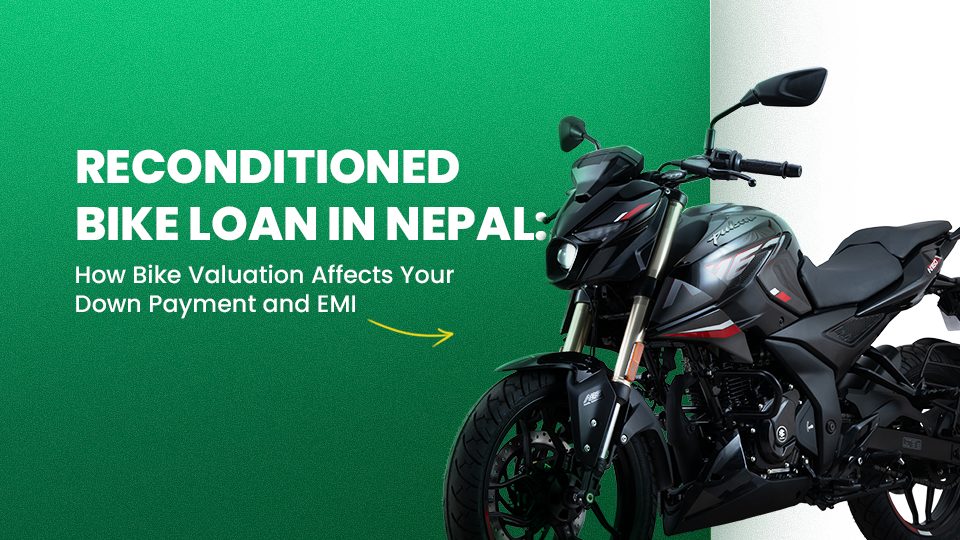
A reconditioned bike loan in Nepal helps you buy a used motorcycle without paying the entire cost upfront. The most important factor is the bike’s valuation because it determines how much you need to pay as a down payment and how much remains to be financed. With Hulas Finserv’s reconditioned bike financing plan, buyers can get financing with a 50% down payment, 9.99% interest rate, and an 18-month tenure with their citizenship only.
This means a higher-valued bike generally requires a higher upfront payment and creates a larger financed amount. A lower used bike valuation, on the other hand, reduces both the amount you need initially and the loan amount used to calculate your monthly EMI.
So, before choosing a second hand bike on EMI, it helps to understand how the bike is valued, how that valuation affects financing, and whether the resulting monthly payment fits comfortably within your budget.
A reconditioned bike loan is a financing option that allows you to purchase a previously owned motorcycle by paying part of its value upfront and repaying the financed portion through monthly installments.
Instead of paying the complete price of the bike in cash, you make the required down payment. The remaining eligible amount is financed and repaid over the agreed loan tenure with applicable interest.
A used bike loan can therefore be useful for buyers who need a motorcycle for commuting, work, studies, deliveries, or everyday transportation but prefer not to use a large amount of their savings at once.
When buying a brand-new motorcycle, determining its price is relatively straightforward because there is an established selling price for a new unit.
A used motorcycle is different.
Two bikes of the same model can have different values depending on their age, condition, usage, maintenance history, and other factors. This is why second hand bike valuation becomes important when financing a reconditioned motorcycle.
In simple terms:
Bike valuation → determines financing base → affects down payment → affects loan amount → affects EMI
For example, imagine you are considering two reconditioned bikes:
If the applicable financing structure requires you to pay 50% upfront, Bike B requires a larger down payment and leaves a larger amount to be financed.
So you should not compare reconditioned bikes only by asking, “What is the selling price?”
A better question is:
“What is the accepted valuation of the bike, and what will my down payment and EMI be based on that amount?”
The connection between valuation and down payment is straightforward.
For Hulas Finserv’s reconditioned bike financing, buyers can get a loan with a 50% down payment, a 9.99% interest rate, and an 18-month repayment tenure. These terms help make it easier to plan both the upfront payment and monthly EMI when purchasing a second-hand bike.
Using that current structure as an example:
Down Payment = Bike Value × 50%
If the accepted bike value is NPR 250,000:
50% down payment = NPR 125,000
The remaining NPR 125,000 becomes the amount to be financed, subject to approval and applicable terms.
For a bike valued at NPR 300,000:
50% down payment = NPR 150,000
The remaining amount:
NPR 300,000 – NPR 150,000 = NPR 150,000
So the estimated financed amount becomes NPR 150,000.
For a bike valued at NPR 400,000:
50% down payment = NPR 200,000
The remaining NPR 200,000 would be the estimated amount financed under a 50% financing structure.
This shows why second hand bike valuation needs to be considered before choosing a bike. A more expensive motorcycle does not only increase your purchase price. It also increases the cash you need for the down payment.
Your EMI is mainly influenced by three factors:
The larger the amount financed, the higher the monthly EMI will generally be.
The interest rate determines how much interest is added to your repayment.
A longer tenure usually spreads repayment across more months, while a shorter tenure requires the amount to be repaid more quickly.
For Hulas Finserv’s dedicated reconditioned-bike plan, the applicable financing terms include a 9.99% interest rate and an 18-month tenure.
Using those figures, approximate EMI examples are:
| Bike Valuation | 50% Down Payment | Approx. Loan Amount | Approx. Monthly EMI* |
| NPR 250,000 | NPR 125,000 | NPR 125,000 | NPR 7,507 |
| NPR 300,000 | NPR 150,000 | NPR 150,000 | NPR 9,008 |
| NPR 350,000 | NPR 175,000 | NPR 175,000 | NPR 10,509 |
| NPR 400,000 | NPR 200,000 | NPR 200,000 | NPR 12,010 |
These are illustrative estimates calculated using a 9.99% annual interest rate over 18 months. Your actual EMI can vary depending on the lender’s final approved valuation, calculation method, financing terms, and other applicable conditions. Hulas Finserv also provides an EMI calculator on its website for estimating repayments.
The pattern is clear:
Higher valuation = higher down payment + higher loan amount + higher EMI
That is why your decision should be based on affordability, not simply on finding the highest-value bike you qualify to finance.
Several characteristics can influence the value of a second-hand motorcycle. Understanding them can help you evaluate whether the asking price of the bike makes sense before applying for finance for a 2nd hand bike.
A newer motorcycle will generally retain more value than an older example of the same model, provided other factors are similar.
However, age alone does not determine value. A well-maintained older motorcycle can sometimes be in better practical condition than a poorly maintained newer one.
Demand in the used-bike market can vary between brands and models.
Motorcycles that are widely used, easy to maintain, and supported by readily available parts may hold their value differently from less common models.
The bike’s visible condition can affect its value.
Important areas can include:
Minor cosmetic wear is normal on a used bike, but significant damage can influence how a motorcycle is valued.
Mechanical condition is particularly important because major repair requirements can increase the real cost of owning a second-hand motorcycle.
Buyers should pay attention to the engine, transmission, brakes, suspension, electrical components, and other key mechanical systems before finalizing a purchase.
Mileage provides some indication of how extensively a motorcycle has been used.
However, mileage should not be considered by itself. Service history and maintenance quality also matter when judging the condition of a used motorcycle.
Regular servicing can help preserve a motorcycle’s condition.
When evaluating a used bike on EMI, available maintenance records can also give you a better idea of how the previous owner cared for the bike.
Valid and complete vehicle documents are important when purchasing a used motorcycle. Confirm the relevant ownership and vehicle documents before committing to a purchase or financing arrangement.
Many buyers start by selecting a motorcycle and then ask whether they can afford the EMI.
A better approach is to reverse the process.
Start with the monthly amount you can reasonably manage.
Look at your regular monthly income and expenses.
Include costs such as:
The EMI should leave enough room for your normal financial responsibilities.
For Hulas Finserv’s current reconditioned-bike plan, the published rate table lists a 50% down payment.
If you have NPR 150,000 available for a down payment, for example, a bike valued around NPR 300,000 would match a 50% down-payment structure.
Once you know the bike valuation and required down payment:
Loan Amount = Bike Valuation – Down Payment
For a NPR 300,000 bike:
NPR 300,000 – NPR 150,000 = NPR 150,000 financed
Use the Hulas Finserv EMI calculator to estimate your monthly installment before applying. The calculator allows users to enter a loan amount and repayment period to estimate monthly repayment.
This makes comparing several bikes easier.
Instead of simply asking whether you can get a 2nd hand bike loan, you can compare which motorcycle gives you an EMI that fits your monthly budget.
Suppose you are choosing between two bikes.
Bike valuation: NPR 280,000
50% down payment: NPR 140,000
Estimated loan amount: NPR 140,000
Bike valuation: NPR 360,000
50% down payment: NPR 180,000
Estimated loan amount: NPR 180,000
Option B requires NPR 40,000 more upfront.
It also requires financing NPR 40,000 more.
Even if you can arrange the larger down payment, ask yourself whether the additional monthly EMI makes financial sense.
If Option A already provides the performance, condition, and features you need, choosing the lower valuation can free up money for fuel, maintenance, insurance, and other expenses.
This is one of the biggest advantages of checking second hand bike valuation before making an emotional purchase decision.
If you are considering a 2nd hand bike on EMI, understanding the financing process beforehand can make the application easier.
Choose a motorcycle based on your actual needs, not only appearance or engine size.
Consider your:
Understand the valuation used for financing.
This tells you how much down payment you need and how much may be financed.
Based on Hulas Finserv’s currently published reconditioned-bike rate table, the down payment is 50% of the applicable cost.
Calculate the remaining financed amount and use the EMI calculator before submitting your application.
Hulas Finserv’s online eligibility flow asks whether the applicant is a Nepali citizen, has regular cash flow, can afford the monthly installment, and can provide a personal guarantor. Final eligibility depends on the documents and application assessment.
The current Hulas Finserv reconditioned-bike page lists basic documents including:
Additional documents apply to business applicants and requirements can vary according to the applicant, product, or business.
Checking the current requirements directly before applying is recommended because documentation policies can change.
If you are comparing bike loan vs full cash payment, read more about the benefits of taking a bike loan instead of paying full cash in Nepal to understand how financing can help you manage your upfront and monthly expenses.
If the estimated EMI feels too high, do not automatically stretch your monthly budget.
Instead, reconsider the bike’s valuation.
This is the most direct approach.
A lower used bike valuation means a smaller down payment under a percentage-based structure and a smaller amount to finance.
Do not settle on the first motorcycle you see.
Compare bikes based on:
A bike that costs slightly less but is in good condition may produce a much more comfortable monthly repayment.
Do your calculations before finalizing the bike.
Hulas Finserv provides an EMI calculator that can help estimate the monthly amount based on the financing details entered.
This allows you to identify an affordable range before committing to a purchase.
Hulas Finserv provides dedicated financing for reconditioned bikes in Nepal.
Its reconditioned bike plan includes:
Understanding the valuation first allows you to use these financing options more effectively rather than selecting a motorcycle without knowing the actual upfront and monthly commitment.
Getting a reconditioned bike loan in Nepal becomes easier to plan when you understand the role of bike valuation.
The valuation is not simply a number attached to a used motorcycle. It directly influences your required down payment, the amount you need to finance, and your monthly EMI.
Before choosing a used bike on EMI, compare several motorcycles, check their condition and valuation, calculate the upfront payment, and estimate the EMI. A bike with a lower valuation may sometimes be the better financial choice if it meets your daily needs without putting unnecessary pressure on your monthly budget.
The smartest way to choose a second-hand motorcycle is simple: check the bike, understand its valuation, calculate the down payment, estimate the EMI, and then decide whether the total commitment fits your budget.
Hulas Finserv’s reconditioned bike financing terms require a 50% down payment, along with a 9.99% interest rate and an 18-month tenure. Rates and financing terms are subject to change, so check the latest applicable terms before applying.
The used bike valuation helps determine the amount on which financing is based. If the applicable financing structure covers 50% of the bike’s value, a bike valued at NPR 300,000 would require an estimated NPR 150,000 down payment and leave around NPR 150,000 to be financed, subject to approval and final terms.
Yes. If the financing percentage, interest rate, and tenure remain unchanged, a higher bike valuation results in a larger financed amount and therefore a higher monthly EMI.
Yes. Buyers can use financing options such as a second hand bike loan to pay part of the cost upfront and repay the financed amount in monthly installments. Hulas Finserv currently offers a dedicated financing plan for reconditioned bikes.
Yes. Finance for a 2nd hand bike is available through providers such as Hulas Finserv. Eligibility, valuation, down payment, required documents, and applicable financing terms determine the final approved amount.
Hulas Finserv’s current reconditioned-bike page lists passport-size photographs and citizenship photocopies for the applicant and guarantor, along with a valid driving licence. Additional documentation may apply depending on the application.
First determine the bike’s accepted value and down payment. Subtract the down payment from the valuation to estimate the amount that needs financing. You can then enter the relevant loan details into Hulas Finserv’s EMI calculator to estimate your monthly repayment.
No. A higher valuation normally means a larger down payment and larger EMI when the same financing percentage applies. Choose a bike based on its condition, suitability, total cost, and whether the monthly repayment fits your budget.
Checking Eligibility